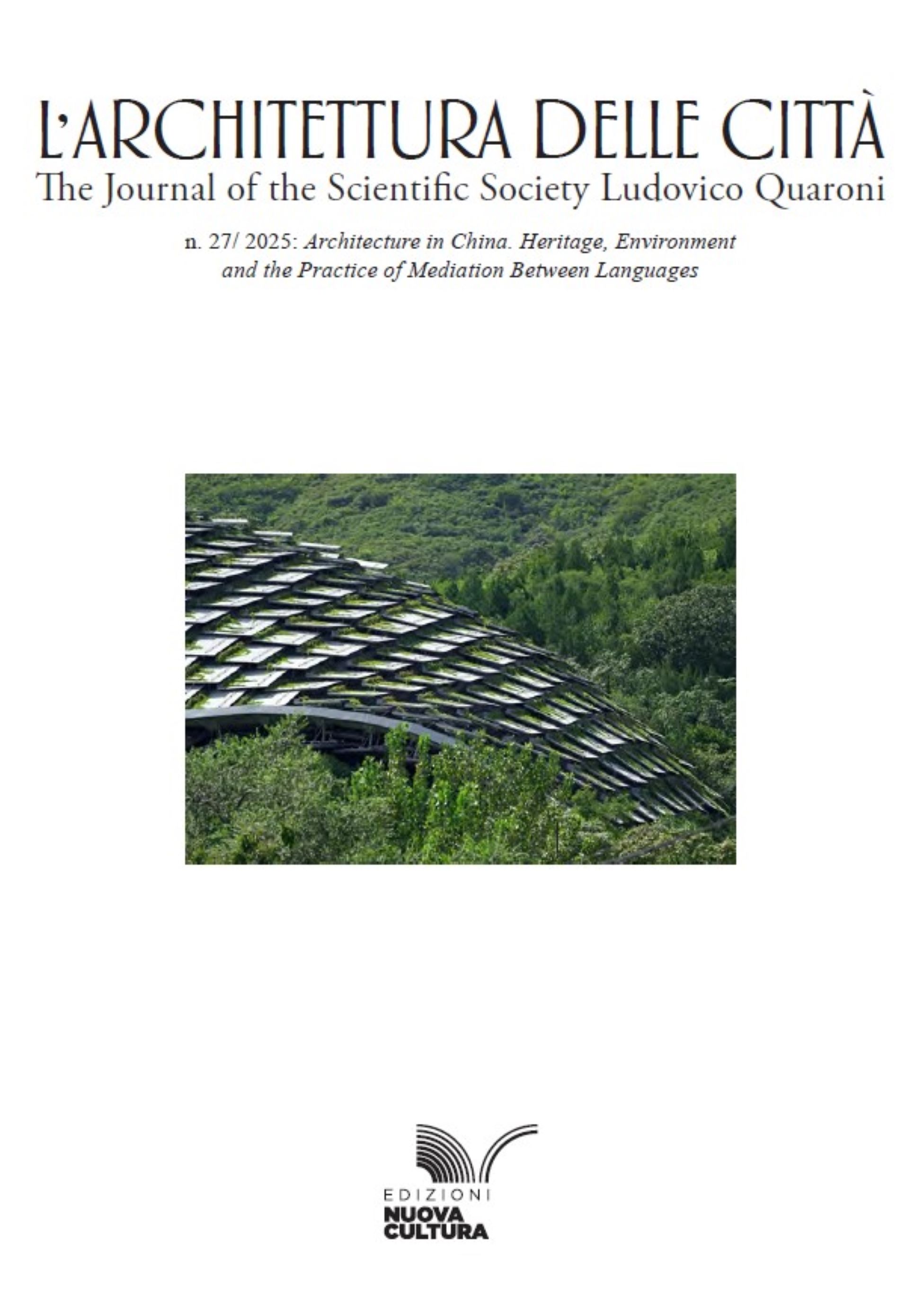
Protective Shelter for the Thousand Buddha Cliff of Guangyuan, Sichuan Province. 2011-2022
Abstract
The protective shelter designed for the Thousand Buddha Cliff in Guangyuan addresses a critical condition in heritage conservation: intervention on an open-air sacred site where sculptural, symbolic and landscape values are inseparable. Carved over several centuries into a limestone cliff, the Buddhist statues have long been exposed to climatic agents, resulting in progressive material decay while remaining a visible and meaningful landmark within the cultural landscape.
Rather than enclosing the site within a sealed structure, the project adopts a strategy based on passive environmental control and minimal physical interference. A large-span, semi-enclosed architectural skin filters rain, light and airflow while maintaining visual continuity with the cliff and its surroundings. Developed through successive design phases and tested by a full-scale pilot section, the shelter demonstrates how environmental protection can be achieved without suppressing the perceptual and symbolic presence of the site. The architecture operates as a mediating layer between conservation requirements and cultural visibility. By reinterpreting traditional construction principles and spatial references without literal imitation, the project reframes the experience of the Buddha Cliff as both protected heritage and living place of contemplation. The Guangyuan intervention thus exemplifies an architectural approach in which preservation, landscape and transmission of meaning are held in deliberate tension, transforming conservation constraints into a generative design condition.
References
Icomos, Xi’an Declaration on the Conservation of the Setting of Heritage Structures, Sites and Areas, 2005.
Liang Sicheng, The Chinese Architecture: A Pictorial History, Dover Publications 2005 (1984).
Peter Rowe, Seng Kuan, Essenza e Forma. L'architettura in Cina dal 1940 a oggi, Postmedia book, 2005.