Current Issue
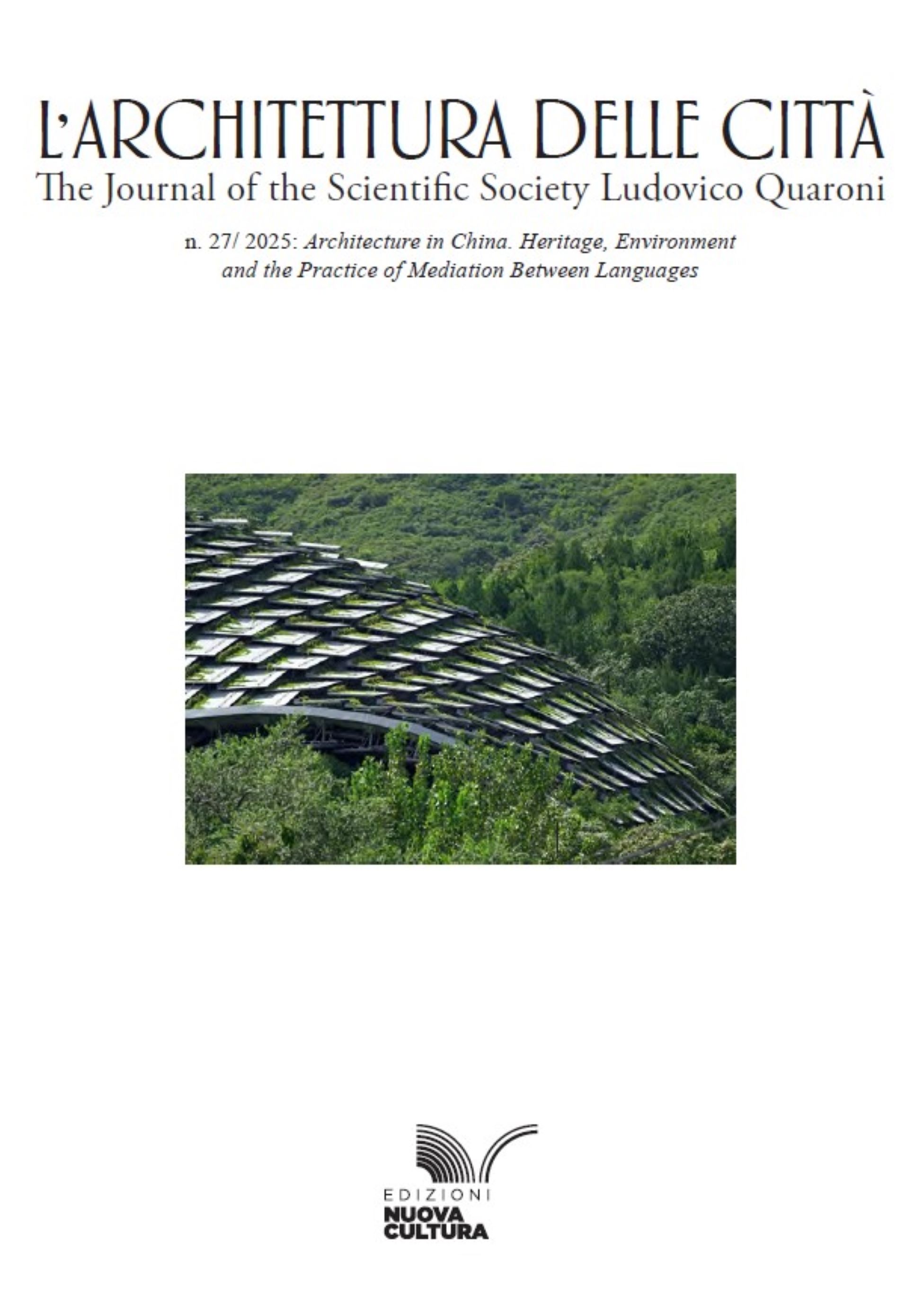
Architecture in contemporary China is increasingly confronted with conditions that exceed the traditional boundaries of design as formal invention. Rapid institutional transformation, large-scale heritage management, and the coexistence of long historical continuities with accelerated modernisation have foregrounded architecture’s role as a mediating practice, rather than as an expressive or representational discipline. In this context, architectural projects are often required to negotiate between preservation and transformation, global technical standards and local spatial conventions, long-term cultural legitimacy and immediate institutional demands.
Unlike the Western modern project, often grounded in rupture, autonomy and expressive individuation, the Chinese condition examined here operates through institutional continuity and regulated transformation.
The four projects of institutional architecture discussed here may be read as contemporary episodes within a long historical trajectory in which architecture in China is not primarily conceived as an expressive language, but as a regulative form, capable of mediating between cultural continuity, historical transformation and institutional responsibility.
Read together, the four projects presented in this issue suggest a specific interpretation of contemporary institutional architecture in China. Rather than pursuing formal autonomy or symbolic rupture, they operate as mediating structures, designed to protect, organise and transmit cultural content across different temporal scales.
In this sense, architecture is not conceived as an expressive language, but as a regulated practice grounded in continuity, repetition and controlled variation. Whether addressing archaeological heritage, sacred landscapes, scientific knowledge or architectural education, each project functions as an infrastructural device that enables access without exhaustion, visibility without exposure, and use without loss of meaning.
This approach resonates with a longer historical trajectory in which cultural production in China has been structured through shared codes and canonical systems, privileging stability over originality and coherence over individual expression. Far from implying a return to tradition, the projects demonstrate how contemporary architecture can engage critically with institutional frameworks, transforming constraints into operative principles.
Ultimately, the four cases illustrate an architectural position in which design acts as a form of cultural stewardship: not by representing history or knowledge, but by constructing the conditions for their continued existence and transmission.
The aim of this essay is to provide a temporary snapshot of architectural practice in contemporary China, focusing exclusively on public and institutional architecture. Four recently completed projects are presented and examined, each addressing issues related to the protection and valorisation of cultural heritage, cultural tourism, and university education.
The projects, listed herafter, span a time frame from approximately 2012 to 2022.
Protective Shelter for the Archaeological Site of Peking Man Cave (Zhoukoudian, Beijing. 2013-2018)
Protective Shelter for the Thousand Buddha Cliff of Guangyuan (Sichuan Province. 2011-2022)
Rizhao Science and Technology Museum (Rizhao, Shandong Province. 2014-2020)
New School of Urban Design, Wuhan University Campus Wuhan (Hubei Province, 2016–2020).
Edited by: Ilaria Bernardi, Anna Irene Del Monaco, Andrea Giannotti. ISBN 9788833658865 | DOI: 10.4458/8865

